Buff’s Backyard Orchard at 30th Street
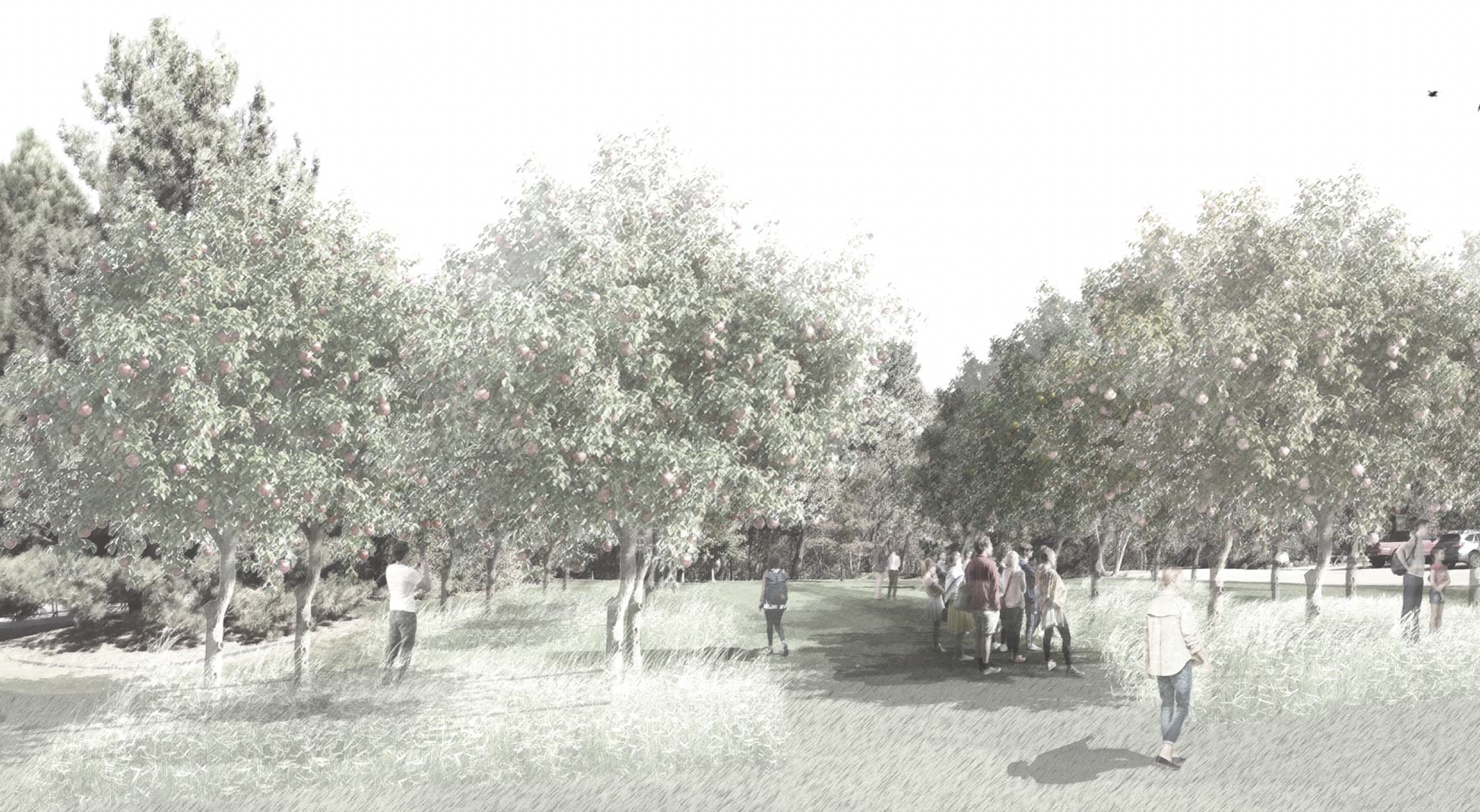
Artist depiction of the Buff’s Backyard Orchard as a mature site with fruit bearing trees.
Growing towards a biodiverse and Sustainable landscape
Apple orchards once grew on this land donated to CU in the 1870s. Long before this, the area was part of the Front Range prairie stewarded by Indigenous peoples, shaped by native grasses and wildflowers adapted to local conditions. This project brings that layered history back to campus through sustainable practices that honor the land's ecological heritage. Replacing turf with drought-tolerant grasses and wildflowers improves soil health, boosts carbon storage, and supports pollinators while reducing fertilizer, water, and mowing. Apples harvested here will support the BUFF Pantry, serving students experiencing food insecurity. The orchard is an accessible site for the University of Colorado and broader community where people can learn firsthand about ecosystems, permaculture, food systems, and land stewardship. Please click through the links below to learn more about the cultivars growing at our orchard and the different understory plants that can be seen during the growing season.
-
Haralson: a hardy apple variety known for its cold-hardiness and tart flavor. It's a cross between a Malinda and a Wealthy apple, resulting in large, tart, and firm fruit.
Macoun: a popular, dessert-style apple known for its sweet-tart flavor, aromatic fragrance, and firm, crisp flesh. It's often compared to McIntosh apples, but with a more complex flavor profile and firmer texture. Macoun apples are a cross between McIntosh and Jersey Black apples, developed in the early 20th century.
Wealthy*: popular, hardy apple variety known for its cold tolerance and ability to thrive in the Upper Midwest. The Wealthy apple is a medium-sized, tart-sweet fruit with a green base and a red blush, often used for both eating and cooking.
Colorado Orange*: a historically significant apple cultivar, not a citrus fruit like an orange. It's known for its long storage life, unique citrus-like flavor, and yellowish-orange color with a blush where exposed to the sun. The cultivar was developed in Florence, Colorado, by Jesse Frazier in the late 1860s. Rediscovered by Montezuma Orchard Restoration Project.
Sweet Sixteen: 'Sweet Sixteen' is a cross between M. 'Malinda' and M. 'Northern Spy'. It was introduced by the University of Minnesota in 1977 and has good winter hardiness.
Cortland: Cortland is a cultivar of apple developed at the New York State Agricultural Experiment Station in Geneva, New York, United States in 1898. It is a cross of the McIntosh and Ben Davis apples. It was named after nearby Cortland County, New York.
Baldwin: The Baldwin apple is a bright red winter apple, very good in quality, and easily shipped. It was for many years the most popular apple in New England
Bobolink*: local beloved tree from the Bobolink Trail
Fireside: developed in the early 1940's when the country listened to Roosevelts' "Fireside Chats" which likely beget its name. This large apple is extremely hardy. The crisp, juicy, sweet, greenish-white flesh is not flat or mealy. Flame orange striped skin over a rich yellow undercover. It is long keeping and flavorful.
Golden Russet (Russet*): old American cultivar of domesticated apple which is excellent for fresh eating as well as for apple cider production. It is a russet apple and is therefore especially used as a cider apple. It is sometimes known as 'English Golden Russet', and has frequently been confused with 'English Russet'.
State Fair: a medium-sized, bright red-striped apple, known for its semi-sweet to acidic flavor and juicy, yellow flesh. It was developed at the University of Minnesota and is considered a cold-hardy variety. The apples ripen in late September to early October and are suitable for eating fresh, baking, or making sauce.
Ashmead's Kernel: one of a very small band of apple varieties from the Old World that succeeded in the New World. When the first settlers arrived in North America they brought with them tried and tested varieties from Europe, yet few adapted to the very different climates of North America and most of the early successful American apple varieties were chance seedlings which evolved in America.
Wolf River*: Wolf River is an American cultivar of domesticated apple, which originates from the shores of the Wolf River of Wisconsin, in the United States of America, known since 1875. The tree is exceptionally frost hardy and generally disease resistant. The fruit usually ripens mid-September to early October.
Mutsu (aka Crispin): cultivar between Golden Delicious and Indo, introduced from Japan. It is a triploid, self-sterile, and poor at pollinating other apple trees.
Hewe's Virginia Crab: a small, flattened, yellow apple with a rose-to-red blush and white specks. Makes a clear, dry, cinnamon-flavored cider. Slow to ferment and the flavor lasts if aged. It has a long bloom period (blooms during categories 1-4) and is an excellent pollinizer.
-
Water Wise Understory plants: mixture of prairie grasses, front range wildflowers including:
Asclepias tuberosa
Bouteloua curtipendula
Eriogonum umbellatum
Schizachyrium scoparium
Trifolium repens
Liatris punctata
Dalea purpurea
Sphaeralcea coccinea
Cleome serrulata
Ratibida columnifera
Chamaecrista fasciculata
Coreopsis tinctoria
Dalea candida
Desmanthus illinoensis
Echinacea angustifolia
Gaillardia pinnatifida
Gaillardia pulchella
Helianthus petiolaris
Machaeranthera tanacetifolia
Thelesperma filifolium
Tradescantia occidentalis
Verbena stricta
-
Pollinator Understory plants: wildflowers found in the high plains and front range
Agastache urticifolia
Aquilegia caerulea
Elymus elymoides
Erigeron speciosus
Festuca arizonica
Gaillardia aristata
Hedysarum boreale
Helianthus annuus
Heliomeris multiflora
Heterotheca villosa
Linum lewisii
Lupinus argenteus
Machaeranthera bigelovii
Penstemon strictus
Penstemon unilateralis
Poa secunda
Potentilla fissa
Rudbeckia hirta